Insights - Investment Management
An Odyssey Through Uncertain Markets

Q2 2026 in Review
There have been several disruptive activities going on throughout much of 2026 that one might expect to impact investment returns. Each gives rise to the next.
- War in the Middle East
- Disruption of the world oil supply coming out of the Persian Gulf
- Higher gasoline prices
- Risk of general inflation increasing as a successive result
How have the U.S. stock markets responded to all of this?
Through June 30, 2026, the year-to-date return of the S&P500 domestic large stock index is +10.2%. In the domestic small-stock realm, the year-to-date return of the Russell 2000 index is +22.6%.
The present moment provides a useful opportunity to look through the lens of our investing “shibboleths,” as shared at our conference on April 24.
These are:
- Valuations matter (Price/Earnings Ratios)
- (Therefore) Earnings matter
- Avoid the crowded trade (“don’t buy or sell because everyone else is” – i.e., SpaceX -cannot be repeated too often)
- Diversification helps (but there is such a thing as too much diversification
- The correct concentrated bets can boost performance
- You will never outperform the S&P500 by investing in the S&P500
Warning: there is some math involved here. When we refer to “valuations,” we are thinking of price/earnings ratios, referred to as P/E ratios. We derive Price/Earnings ratios by dividing the price per share of company stock by the actual recent earnings per share of the same company’s stock.
If we apply that calculation to the entire S&P500 index of 500 companies, we find that the current P/E ratio of the S&P500 is 26.8 (the price is 26.8 times the earnings). Another way to think of that number is that it would take an investor 26.8 years to receive enough “earnings” through their ownership of purchased shares to recover the original cost of shares bought today. If we look at longer periods of S&P500 history, we find that the long-term P/E ratio is in the range of 15-20 times earnings. Therefore, 26.8 is comparatively high.
We have observed this relatively high valuation for quite a while now, and it is due to the “Mag 7” stocks that comprise 37% of the value of the S&P500. Just for fun, let’s dig into the “Mag 7” just a bit here.
- Apple P/E is 38.1
- Amazon P/E is 29.6
- Nvidia P/E is 32.4
- Meta P/E is 24
- Microsoft P/E is 22.9
- Alphabet (Google) P/E is 27.3
- Tesla P/E is 363.5
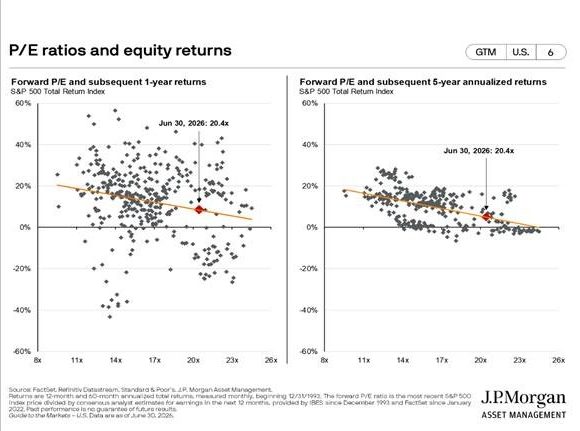
As you can see, the P/E ratios of the Mag 7 range from a low of 22.9 to a high of 363.5! When P/E ratios deviate significantly from long-term norms, history tells us that EITHER earnings will “catch up” to justify the stock price OR the stock price will fall to a level more in line with the earnings. At any point in time, valuations are a poor indicator of near-term returns but have been more useful in setting expectations for long-term returns. For a graphical illustration, see below, noting that the reference is to forward-looking P/Es, rather than trailing.
The Artificial Intelligence build-out has been enormously capital-intensive. Initially, many of the players were financing hardware and other infrastructure investments using their retained earnings. More recently, we read that these companies are reporting massive amounts of private debt financing being obtained to fund the data centers that house all the hardware used to deliver “AI” output. This debt service cost is expected to be funded from the income generated by large-scale AI adoption, yet the pricing model and actual demand for AI are still uncertain.
We have been limiting exposure to overvalued companies in this environment. Meanwhile, exposure to domestic small-company stocks has rewarded us with very positive returns. International developed and emerging markets exposure has also rewarded us with very positive returns. In a time of uncertain and disrupted access to traditional sources of energy fuels, alternative energy and related natural resources exposure is rewarding us. We are pleased to see performance from stock market exposure that is enhanced through diversification and with less risk exposure than if we invested in the S&P500 alone.
Referring back to our conference of April 24: we have videos of the talks given by Mark, Hunter, and Kyle. These will be rolled out each of the next 3 Tuesdays. Please be on the lookout for the links and invest the time to listen to what each of us had to say in these heartfelt expressions of what motivates our service to you and your families.
As shared during the conference, Hunter Outen and Kyle Feduccia are now part-owners of Kuhn Advisors. Further, we added Ryan Campbell to our investment team on July 1 following a successful internship. We welcome Ryan, a recent graduate of N.C. State University and a kindred spirit who is drawn to this career path.
As always, we welcome your feedback and questions. The world is navigating through very uneven times, and we continue to apply our discipline in the manner and to the extent that it is under our control.
For the movie buffs among you, “The Odyssey” is a very well-cast retelling of a man’s journey through the particular lens of director Christopher Nolan. One of the haunting lines uttered by Odysseus in the final scene is “We broke the sacred trust between men.” It seems that there is a lot of that going on around the world, adding to the sensation of uncertainty that everyone feels at times.
Very truly yours,
Mark A. Kuhn
The opinions expressed are those of Kuhn Advisors, Inc. The opinions referenced are as of the date of publication and are subject to change due to changes in the market or economic conditions and may not necessarily come to pass. Forward-looking statements cannot be guaranteed. Kuhn Advisors, Inc. utilizes its best efforts that content provided is compiled or derived from sources believed to be reliable and accurate but makes no representation thereof and accepts no liability for any loss arising from the use or reliance herein.
Kuhn Advisors, Inc. is a registered investment adviser with the U.S. Securities and Exchange Commission. Registration does not imply a certain level of skill or training. More information about Kuhn Advisors, Inc., including its advisory services and fee schedule, can be found in its Form ADV Part 2 and/or Form CRS, which is available upon request. KA-25-04.